
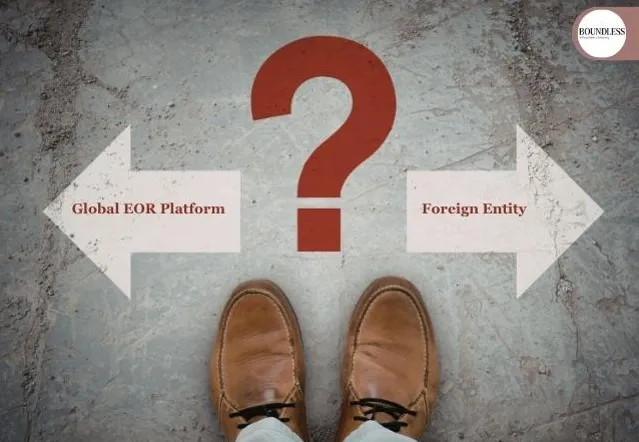

You’re ready to hire talent in the UK, France, or Germany. But you face a critical decision that will impact your expansion timeline, budget, and compliance risk for years to come. Should you establish a foreign entity or partner with a global EOR platform? This choice keeps HR VPs and COOs awake at night. Choose wrong, and you could face tax penalties, delayed hiring, or operational headaches that derail your growth plans. Choose right, and you’ll build a scalable international workforce that drives competitive advantage. This comparison framework cuts through the complexity. You’ll see exact costs, timelines, and risk factors for both approaches. No sales pitch, just the facts you need to make an informed decision.
Understanding Your International Employment Options
Before comparing costs and benefits, let’s establish what each option actually means for your business.
- An Employer of Record (EOR) becomes the legal employer for your international team members. The EOR handles payroll, taxes, benefits, and compliance in each country where you hire. You maintain operational control while the EOR manages legal employment responsibilities.
- Establishing a foreign entity means creating a legal business presence in another country. This involves registering a subsidiary, branch office, or representative office. You become the direct employer and assume all legal, tax, and compliance obligations in that jurisdiction.
Think of it this way: A global EOR platform lets you hire immediately without establishing your own legal infrastructure. A foreign entity gives you complete control but requires significant upfront investment and ongoing management. Each approach serves different business needs. The right choice depends on your expansion timeline, budget, risk tolerance, and long-term strategy.
Cost Comparison: EOR Services vs. Entity Setup
Money talks when executives evaluate international expansion options. Here’s what you’ll actually pay for each approach.
Foreign Entity Setup Costs:
- Initial registration: $15,000 to $50,000 per country
- Legal and accounting setup: $10,000 to $25,000
- Bank account establishment: $2,000 to $5,000
- Office address requirement: $500 to $2,000 monthly
- Total first-year setup: $40,000 to $100,000+ per country
Ongoing Entity Costs:
- Local accounting: $2,000 to $5,000 monthly
- Legal compliance: $1,000 to $3,000 monthly
- Payroll processing: $500 to $2,000 monthly
- Annual audits: $10,000 to $25,000
- Tax filings: $5,000 to $15,000 annually
Employer of Record Costs:
- Setup fee: $0 to $1,000 per employee
- Monthly service fee: $500 to $2,000 per employee
- No infrastructure costs
- No separate accounting fees
- Compliance included in service fee
The math becomes clear when you calculate total costs. Hiring five employees through an entity costs $60,000+ in year one. The same team through an EOR costs $30,000 to $60,000 with no upfront investment. Hidden costs matter too. Entities require dedicated staff to manage compliance, increasing your internal overhead. Mistakes in tax filings or labor law compliance can trigger penalties ranging from $10,000 to millions.
Timeline and Speed to Market
Speed kills deals in competitive talent markets. Your timeline determines whether you land top candidates or watch them join competitors.
Foreign Entity Timeline:
- Research and planning: 2 to 4 weeks
- Legal entity formation: 4 to 12 weeks
- Bank account setup: 2 to 6 weeks
- Tax registration: 2 to 4 weeks
- Payroll system setup: 2 to 4 weeks
- Total time to first hire: 3 to 6 months
Some countries move faster. Others crawl. France requires multiple government approvals that stretch timelines. Germany demands extensive documentation. The UK moves relatively quickly but still takes 8 to 12 weeks minimum.
Global Employment Solution Timeline:
- Platform evaluation: 1 to 2 weeks
- Contract negotiation: 3 to 5 days
- Employee onboarding: 2 to 5 days
- Total time to first hire: 2 to 3 weeks
Real scenario: A SaaS company needed to hire a sales director in Germany. Entity setup would take four months. They used an EOR and had their candidate working in 10 days. That speed secured the hire and accelerated their European revenue by two quarters. Timing impacts more than just hiring. Slow entity setup delays product launches, customer implementations, and market entry. Every week matters when you’re racing to establish market presence.
Compliance and Legal Risk Management
Compliance failures destroy companies. One misclassified contractor or missed tax filing can trigger audits, penalties, and reputational damage that takes years to repair.
Permanent Establishment Risk: Your biggest fear should be accidental permanent establishment (PE). PE occurs when tax authorities determine you’re conducting business in their country without proper registration. Consequences include:
- Back taxes on all revenue attributed to that country
- Penalties up to 200% of unpaid taxes
- Criminal charges against directors in severe cases
- Forced entity establishment under unfavorable terms
Foreign entities eliminate PE risk by establishing legal presence upfront. But you assume full responsibility for ongoing compliance.
Labor Law Complexity: Each country enforces unique employment laws. France mandates specific termination procedures. Germany requires works councils for larger teams. The UK enforces strict pension requirements. Miss any requirement and face lawsuits, fines, or employee claims. A global EOR platform assumes these compliance risks. Their legal teams monitor regulatory changes and update employment contracts automatically. You avoid the cost of international law firms and the risk of missing critical updates.
Tax Compliance: International tax compliance involves:
- Monthly payroll tax filings
- Annual corporate tax returns
- VAT/GST registration and reporting
- Transfer pricing documentation
- Social security contributions
Entities must manage each requirement internally or hire local accountants. EORs handle everything as part of their service. The difference in complexity and risk is substantial.
Operational Control and Flexibility
Control matters to executives. You want to manage your team effectively while maintaining flexibility for future changes.
Day-to-Day Management: Both options let you manage employees directly. You set work schedules, assign projects, conduct reviews, and make promotion decisions. The employment structure doesn’t change your operational control. Entities give you complete control over employment terms, benefits packages, and company policies. You design everything to match your culture and standards. EORs provide standard employment contracts that comply with local laws. You can often customize benefits and compensation within legal limits. High-quality EORs offer flexibility while ensuring compliance.
Scaling Considerations: Entities work well for steady, predictable growth. Once established, adding employees becomes routine. But scaling down proves difficult. Closing entities takes months and costs thousands in legal fees. International expansion through EORs offers maximum flexibility. Add employees as needed. Reduce headcount without entity closure costs. Test new markets without long-term commitments.
Exit Strategies: Business conditions change. Markets disappoint. Strategies pivot. Your employment structure should support, not constrain, business decisions.
Exiting an entity requires:
- Employee termination procedures
- Asset liquidation
- Tax clearances
- Legal dissolution
- Total time: 6 to 12 months
- Total cost: $20,000 to $50,000+
Exiting an EOR relationship requires:
- Employee transition planning
- Contract termination notice
- Total time: 30 to 90 days
- Total cost: Minimal to none
When to Choose Each Option
Clear scenarios determine the right choice for your business. Match your situation to these decision criteria.
Choose a Global EOR Platform When:
- Hiring fewer than 10 employees per country
- Testing new markets before committing
- Needing to hire within 30 days
- Lacking internal legal and tax expertise
- Expanding into multiple countries simultaneously
- Operating in Europe, Middle East, or Africa with small teams
Choose Foreign Entity Setup When:
- Building teams of 20+ in a single country
- Establishing permanent operations
- Requiring specific banking relationships
- Needing complete control over employment terms
- Planning major capital investments
- Operating in countries with favorable entity regulations
Regional Considerations: Europe presents unique challenges. Complex labor laws and high compliance costs make EORs attractive for smaller teams. Entities make sense for major operations centers. Middle East regulations vary dramatically by country. Some nations require local partners for entities. Others offer free zones with simplified setup. EORs provide consistent solutions across the region. Africa’s diverse regulatory landscape favors EOR solutions for most companies. Entity establishment often requires local shareholders and faces bureaucratic delays.
Making Your Decision
Your choice between a global EOR platform and foreign entity setup shapes your international success. The decision isn’t about which option is universally better. It’s about matching the solution to your specific needs.
Key differences to remember:
- Entities require 3 to 6 months and $40,000+ to establish
- EORs enable hiring in 2 to 3 weeks with minimal upfront costs
- Entities provide complete control but full compliance responsibility
- EORs assume compliance risk while maintaining your operational control
- Entities suit permanent, large-scale operations
- EORs excel for flexible, fast-moving expansion
Start by answering three questions:
- How quickly do you need to hire?
- How many employees will you have in each country?
- What’s your risk tolerance for compliance issues?
Your answers point toward the right solution. Need speed and flexibility? Choose an EOR. Building a permanent presence with large teams? Establish an entity. For companies expanding globally across the UK, Europe, Middle East, and Africa, the hybrid approach often works best. Use an entity-owned EOR platform for initial expansion, then establish entities in countries where you build larger teams. This strategy balances speed, cost, and control while minimizing risk.